As Deputy CEO of Contact, NI charity specialising in crisis counselling and suicide prevention, the greatest leadership challenge I face is how to co-create a just culture.

Contact renewed vision aspires to ‘society free from suicide’ (March 2016) building upon the WHO 2014 declaration that suicide is preventable. Our vision spurred sign-up to the Atlanta Zero Suicide Declaration setting the audacious ambition to render suicide as a preventable harm…a ‘never event’ for the people in our care.
Five years of Contact international suicide prevention conferences resulted in Contact Zero Suicide Manifesto declaring suicide as a preventable harm, eliminating suicide for people in our care as the only target to aim for.
For the past decade Contact has provided Lifeline, Northern Ireland’s 24/7 crisis response helpline and wraparound counselling service under licence to the NI Public Health Agency.
Why is a confident, competent, caring workforce not enough?
Affirming groundwork towards our just culture of innovation and discipline was evident from the results of 2015 Contact Zero Suicide workforce preparedness study A confident workforce noted 91% endorsement for skills training received to assess and engage client suicide desire/intent; 72% confidence rating from all Contact staff capacity to treat people suffering from suicidal thoughts and behaviour and 92% confirming completion of collaborative safety plans with clients who disclose suicide thinking or planning.
Staff confidence was borne out by high levels of professional competence through recent independent clinical outcomes evaluations. More than 5000 clients who received Lifeline crisis counselling support over the past two years completed independent CORE evaluations on every counselling session attended. The independent CORE report found that ‘relative to published benchmarks and academic papers- service quality assessment as exemplary with low rate of unattended sessions and high rates of planned endings to therapy…clinical expertise strongly evidenced through high proportions (70%) of clients meeting criteria for clinical recovery and empirical improvement’.
Despite exemplary client feedback and CORE workforce competence our mission of ‘getting you through the most difficult times’, extended to more than 50,000 Lifeline callers over this past decade, sadly more than 150 Lifeline callers lost their lives to suicide throughout that initial ten year period. In real terms 22% Contact crisis counsellors have lost a client to suicide and a further 12% have experienced this tragedy more than once.
The not-so-secret sauce…towards a Just Culture
Recent high profile public inquiry and review highlight strong links between organisational culture, leadership and safety standards. The Francis report noted that Mid Staffordshire NHS Foundation Trust (2013) ‘above all failed to tackle an insidious negative culture involving a tolerance of poor standards and a disengagement from managerial and leadership responsibilities’. Sir Liam Donaldson’s expert panel review of NI sector leadership (2014) emphasised that “Prominent in international experience are four essential ingredients to improving the quality and safety of care…clinical leadership, culture change, data linked to goals and standardisation.”
Constructive criticism on how current limitations to health care leadership vision translates into progressive action include reflection on the lamentably slow pace change and the absence of ambition for consistently excellent client outcomes. These themes were crystalised by Prof. Ed Coffey, Henry Ford Health Care presentation to Contact 2014 Suicide Prevention conference. Coffey’s ground-breaking work referenced ‘just culture’ as a fundamental systems leadership concern when Pursuing Perfect Depression Care: A Model for Eliminating Suicide and Transforming Mental Healthcare
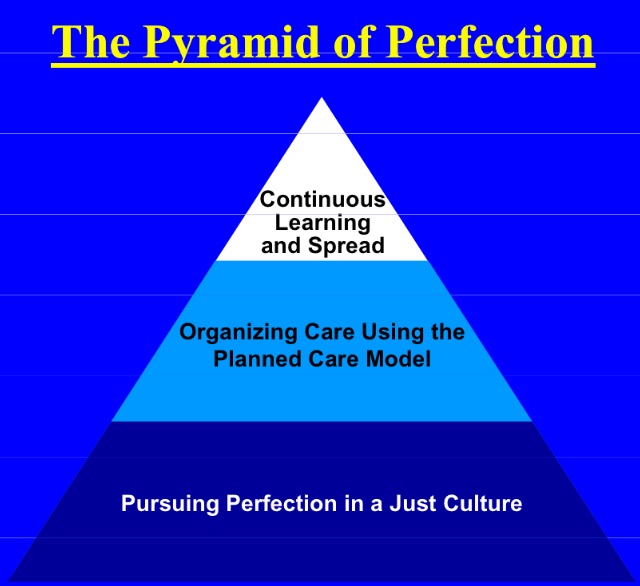
Contact 2016 Zero Suicide manifesto defines perfect crisis care by 100% commitment to a ‘no blame’ culture, championed by accessible, visible and competent leadership accountability. This means immediate learning from honest mistakes celebrated as opportunities to achieve continuous service improvement excellence. This commitment also means ensuring a compassionate yet disciplined professional work culture of performance appraisal by results, and clear evidence upon which all staff appraisals are made.
Easier said than done.
If like me, you are a pragmatist, who yearns for tangible practical solutions, by attaining difficult stretch-goals you can’t go wrong with Margaret Heffernan’s Beyond Measure: The Big Impact of Small Changes. Heffernan reflects the purpose of ‘just culture’ is to surface all the information, intelligence, and insight required to make the best decisions.
Noted as a stickler for detailed evidence I was challenged by Heffernan’s statement that ‘we measure everything at work except what counts…numbers are comforting – income, expenditure, productively, engagement, staff turnover – and create an illusion of control’. My default position is ‘show me the evidence’. However, the perception of exclusive reliance upon facts and figures can have exceptional high risk opportunity costs. To privilege hard data risks sabotaging opportunities for novelty and disruptive breakthrough available from dynamic relationships based on constantly tested competence and trust. I discovered by experience that narrowing down of what works to hard data or key performance indicators (KPIs) can stifle creative, imaginative problem solving communication. Relationships that encourage risk-taking in pursuit of excellence gradually build safety through surviving the experience. Regularly encouraging speaking truth to power, welcoming openness and engagement without reprisal can go a long way towards dissolving the limits to status barriers and silos so common within bureaucratic hierarchy . Just culture nourishes straight-talking, with grace and dignity, at every level, valuing evidence based assertiveness, exposing self-serving cronyism, dissolving narrow self-interested cliques, celebrating every contribution to problem-solving while eschewing the tendency to whine!
I am therefore drawn to Heffernan’s Better Questions, Better Decisions providing a structure for good decision making while facilitating consideration of both hard and soft data in addition to tackling hierarchical power imbalances:
- Who needs to benefit from our decision? How?
- What else would we need to know to be more confident of this decision?
- Who are the people affected by this decision; who have the least power to influence it?
- How much of this decision must we make today?
- Why it this important? And what’s important about that?
- If we had infinite resources-time, money, people-what would we do? What would we do if we had none?
- What are all the reasons this is the right decision? What are all the reasons it is the wrong decision?
It seems clear to me that valuing just culture requires more than hard-data driven goals. We must also distinguish and weight the value of facts and figures, the traditional limits to ‘hard data’ from the importance of relationships that can contain and encourage regular difficult conversations. In this way we can build trust through engagement, and survive the awkward, often messy business of conflict, protecting and encouraging speaking truth to power in every relationship. Just culture celebrates the principle that ‘as long as they are well-intentioned, mistakes are not matter for shame but for learning’. This configuration of what constitutes a just culture provides me with a reassuring structure towards achieving objectives, a documented decision making process including the trial and error of difficult learning implementation stories. Good quality documentation means decision are subject to critical analysis and independent review, real time and in detail, enabling immediate, continuous client outcome improvement. Co-creating a disciplined and innovative culture based on systematic, balanced and fair consideration of the competing needs of our stakeholders, people, finances and processes is the essence of just culture. Cultivating social capital acknowledging we needed an answer but we knew that not one of us had it on our own, values connectedness and high performing teamwork. A system collectively striving for the best outcome, no matter how challenging and unattainable it first appears. The best outcome for our system of care at Contact is that not one of our clients, staff or family networks should die alone and in despair by suicide.

Interested to hear of your thoughts and experiences on reflection!
If you are affected by these issues, check out some of the resource list referenced in my blog post here
 Carrie Montgomery