Suicide Prevention

What can lived experience teach us…towards eliminating suicide as a preventable harm?


Contact Zero Suicide Manifesto calls for civic leadership investment and courageous suicide prevention championship, promoting lived experience voices of hope and recovery. This ask got me thinking, how do I feel about sharing lived experience, the ‘me too’ position?

Hands up

Deciding to speak about a troubling personal experience shouldn’t be taken lightly. It’s important to take time to gain perspective from difficult experience. Always consider sharing with a loved one first on the potential impact for family and friends of public speaking, thinking through career and relationship ramifications, digital footprint etc. Despite my ‘health warnings’, benefits from sharing lived experience include prejudice reduction, normalising challenging life struggles, opening the door on previously taboo conversation, reducing isolation and upping social connection.

From professional…

I am not a peer support worker or service user advocate, a role by definition where the person shares distressing experiences and mental health service use to inspire, model, support and inform others in similar situations. I am one of many working in health and social care with hidden experience of suicide bereavement. Increasingly I am aware of how the experience and my silence inevitably affect my work. With my particular early life experience, choosing to work in suicide prevention is no mystery.

A common response when I tell people what I do is ‘I don’t know how you do that’. The inference, ‘why would you do that??’

To personal…

Suicide first visited my life twenty years ago.  Three close friends took their own lives within the space of two years – all young men.  I so desperately needed to know how to prevent another death. I needed the answer to the ‘why?’ question that tortured me and all suicide bereavement survivors.

Reflecting on twenty years since my peer group trauma what’s apparent from the immediate weeks and months following suicide loss is that I didn’t succumb to the myths. I didn’t think ‘they were selfish’…‘there’s nothing I could have done’…‘they decided – I have to respect their choice’. My concern was they couldn’t see a way out from whatever trouble they faced.  They most likely lost hope and couldn’t imagine the impact their death would have on those who loved them.  I didn’t believe that nothing could have helped. I simply didn’t yet know what I might have done to help. I didn’t know what to look for, or what to say if someone close to me was thinking of suicide.  I was eighteen years old.

Suicide bereavement left me struggling with, how do I stop my friends taking their own lives?

So many urgent questions. As a young woman I didn’t have the answers. I didn’t know who to ask. My social circle grieving painful loss in their own way.

  • What could be so terrible to drive three lively, funny, smart young men to end their lives?
  • Why didn’t they talk to me about how they were feeling?
  • Did they not know I cared?
  • Were they thinking straight at the time?
  • How could they do this to me?
  • How would I know if another friend was thinking about suicide?
  • What would I even say to them, even if I noticed?
  • If I noticed, what could I do that would help?

WhyI had no idea how to confront these burning themes. I know now my list of endless questions contributed to my growing sense of despair. Unaware as I was back then, that suicide loss heightens risk for suicide among bereaved friends, loved ones and colleagues.

The burden of not knowing how to help my friends, coupled with my own silent withdrawal from personal trauma contributed to hopeless, suicidal thoughts and a plan to end my life.  

Looking back, my most valuable insight from that time, the burden of overwhelming shame I felt for not coping, was more troubling than thoughts of harming myself. Had Lifeline (Northern Ireland’s 24/7 crisis counselling service – 0808 808 8000) which I now co-lead, been available at the time…I doubt I’d have had the courage to reach for support. Despite some awareness of support services available then, the ‘not coping’ shame thing prevented me from speaking to anyone. This common experience ensures I often ask ‘Are you ok? Is there anything I can do to help?’ and sticking around for the answer. Next step?…actively linking the person in crisis with the right supports at the right time. Never placing the onus on the person in crisis to cross the bridge to professional support unaided, alone.

I look back with admiration for my GP. Having not been near the surgery since routine childhood vaccinations, I was out-of-the-blue attending frequently for a range of minor physical health complaints. Expressing an interest in my emotional wellbeing, my Doc asked ‘have you been thinking about suicide?’ His direct question opened the door. I was swiftly referred to mental health services.

Rather than asking ‘what happened you?’ an enquiry as to what led me to feeling so bad, I was told what was wrong with me…depression.  Rightly or wrongly I sensed my traumatic experience and overwhelming suicide thoughts were too much for the mental health clinician. The ‘S’ word was never mentioned. I was treatment compliant (medication reviews). From this experience I was put off further help seeking, convinced this was something I had to figure out on my own. My sense of isolation accentuated, my recovery further delayed.

Integrated experience…

What I now know is that I was at high risk of suicide. All four key risk factors were present: social isolation, perceived burdensomeness, acquired capacity and access to lethal means.  When I reflect on what stopped my potentially fatal acting out suicide plans during my ambivalent struggle between wanting the pain to end and my fear – no terror – of death. I tried to imagine how my loved ones would react to my suicide. In a moment of clarity, after many months of sleep deprivation and endless distressing rumination, I GHansardrealised that rather than being better off without me, I would be passing the burden on to them. I made (a silent) promise that I wouldn’t act on my thoughts unless I could find the courage to confide in no less than three family members/friends. I never did find that courage to speak to my family, until now. The commitment made to myself placed an obstacle in my way and instantly removed a key risk factor – perceived burdensomeness…I decided they would not be better off without me. My life held value again and I had found a reason to live.

Was I an early spontaneous adopter of collaborative safety planning? I think so! Safety planning is the current best practice standard (recognising warning signs/triggers, identifying support networks and when/how to activate them) recognised as a critical de-escalation and stabilisation safety management measure.

While I found a reason to live and in time made a full recovery, I had what I can only describe as dreadful survivor guilt. Why had I recovered yet my friends ended their lives? This reawakened my motivation to more fully understand suicide and search for how to prevent it. I enrolled for counselling training, an effort to know more, not a career plan. I qualified as a counsellor, completing two separate university diplomas across two modalities. However I received no professional training whatsoever on how to assess and manage suicide risk. Although twenty years on the clinical research literature has improved lots, suicide prevention clinician training within health and social care is not the mandatory gold standard. This gap has resulted in health and social care workforce preparedness survey’s consistently finding that almost half mental health practitioners do not feel confident or competent to work with a suicidal person.

What next?

At times I can be privately despondent with the pace of progress…continuing gaps in mandated suicide risk assessment and management training, pervailing suicide myths such as asking someone directly if they are contemplating suicide may put ideas in their head. My occasional gloom is far outweighed by motivation stumulus from the growing community of system leaders, researchers, clinicians and people with lived experienced choosing to champion suicide prevention messages of hope and recovery. The overwhelming evidence now says clearly that suicide is a preventable harm. By speaking truth to power, breaking down barriers to help seeking and challenging discrimination, I firmly believe we are getting ever closer to the perfect crisis care standard, ensuring that not one person in our care should die alone, in despair by suicide.

 Raise your hopeful voice…you have a choice

~Glen Hansard~

 Interested to hear of your thoughts and experiences on reflection!

If you are affected by these issues, check out some of the resources list referenced in my blog post here

Zero Suicide

Towards a culture change…eliminating preventable harm

As Deputy CEO of Contact, NI charity specialising in crisis counselling and suicide prevention, the greatest leadership challenge I face is how to co-create a just culture.

See no Evil

Contact renewed vision aspires to ‘society free from suicide’ (March 2016) building upon the WHO 2014 declaration that suicide is preventable. Our vision spurred sign-up to the Atlanta Zero Suicide Declaration setting the audacious ambition to render suicide as a preventable harm…a ‘never event’ for the people in our care.

Five years of Contact international suicide prevention conferences resulted in Contact Zero Suicide Manifesto declaring suicide as a preventable harm, eliminating suicide for people in our care as the only target to aim for.

For the past decade Contact has provided Lifeline, Northern Ireland’s 24/7 crisis response helpline and wraparound counselling service under licence to the NI Public Health Agency.

Why is a confident, competent, caring workforce not enough?

Affirming groundwork towards our just culture of innovation and discipline was evident from the results of 2015 Contact Zero Suicide workforce preparedness study  A confident workforce noted 91% endorsement for skills training received to assess and engage client suicide desire/intent; 72% confidence rating from all Contact staff capacity to treat people suffering from suicidal thoughts and behaviour and 92% confirming completion of collaborative safety plans with clients who disclose suicide thinking or planning.

Staff confidence was borne out by high levels of professional competence through recent independent clinical outcomes evaluations. More than 5000 clients who received Lifeline crisis counselling support over the past two years completed independent CORE evaluations on every counselling session attended.  The independent CORE report found that ‘relative to published benchmarks and academic papers- service quality assessment as exemplary with low rate of unattended sessions and high rates of planned endings to therapy…clinical expertise strongly evidenced through high proportions (70%) of clients meeting criteria for clinical recovery and empirical improvement’.

Despite exemplary client feedback and CORE workforce competence our mission of ‘getting you through the most difficult times’, extended to more than 50,000 Lifeline callers over this past decade, sadly more than 150 Lifeline callers lost their lives to suicide throughout that initial ten year period.   In real terms 22% Contact crisis counsellors have lost a client to suicide and a further 12% have experienced this tragedy more than once.

The not-so-secret sauce…towards a Just Culture

Recent high profile public inquiry and review highlight strong links between organisational culture, leadership and safety standards. The Francis report noted that Mid Staffordshire NHS Foundation Trust (2013) ‘above all failed to tackle an insidious negative culture involving a tolerance of poor standards and a disengagement from managerial and leadership responsibilities’. Sir Liam Donaldson’s expert panel review of NI sector leadership (2014) emphasised that “Prominent in international experience are four essential ingredients to improving the quality and safety of care…clinical leadership, culture change, data linked to goals and standardisation.

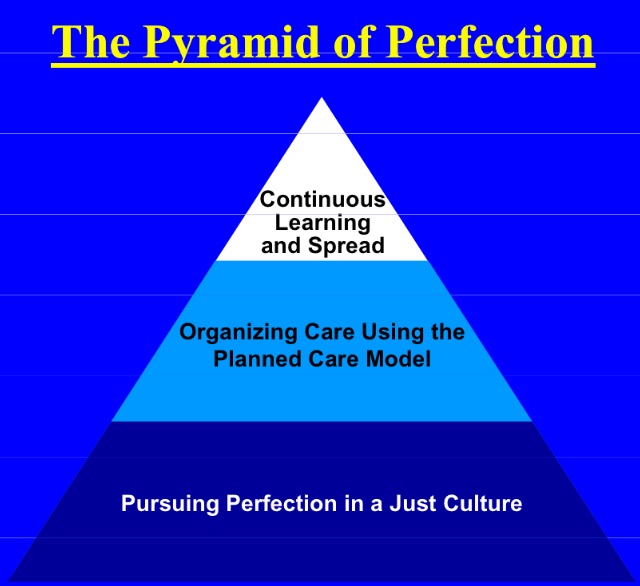
Constructive criticism on how current limitations to health care leadership vision translates into progressive action include reflection on the lamentably slow pace change and the absence of ambition for consistently excellent client outcomes. These themes were crystalised by Prof. Ed Coffey, Henry Ford Health Care presentation to Contact 2014 Suicide Prevention conference. Coffey’s ground-breaking work referenced ‘just culture’ as a fundamental systems leadership concern when Pursuing Perfect Depression Care: A Model for Eliminating Suicide and Transforming Mental Healthcare

Pyramid of Perfection

Contact 2016 Zero Suicide manifesto defines perfect crisis care by 100% commitment to a ‘no blame’ culture, championed by accessible, visible and competent leadership accountability. This means immediate learning from honest mistakes celebrated as opportunities to achieve continuous service improvement excellence.  This commitment also means ensuring a compassionate yet disciplined professional work culture of performance appraisal by results, and clear evidence upon which all staff appraisals are made.

Easier said than done.

If like me, you are a pragmatist, who yearns for tangible practical solutions, by attaining difficult stretch-goals you can’t go wrong with Margaret Heffernan’s Beyond Measure: The Big Impact of Small Changes. Heffernan reflects the purpose of ‘just culture’ is to surface all the information, intelligence, and insight required to make the best decisions.

Noted as a stickler for detailed evidence I was challenged by Heffernan’s statement that ‘we measure everything at work except what counts…numbers are comforting – income, expenditure, productively, engagement, staff turnover – and create an illusion of control’. My default position is ‘show me the evidence’. However, the perception of exclusive reliance upon facts and figures can have exceptional high risk opportunity costs. To privilege hard data risks sabotaging opportunities for novelty and disruptive breakthrough available from dynamic relationships based on constantly tested competence and trust. I discovered by experience that narrowing down of what works to hard data or key performance indicators (KPIs) can stifle creative, imaginative problem solving communication. Relationships that encourage risk-taking in pursuit of excellence gradually build safety through surviving the experience.  Regularly encouraging speaking truth to power, welcoming openness and engagement without reprisal can go a long way towards dissolving the limits to status barriers and silos so common within bureaucratic hierarchy . Just culture nourishes straight-talking, with grace and dignity, at every level, valuing evidence based assertiveness, exposing self-serving cronyism, dissolving narrow self-interested cliques, celebrating every contribution to problem-solving while eschewing the tendency to whine!

I am therefore drawn to Heffernan’s Better Questions, Better Decisions providing a structure for good decision making while facilitating consideration of both hard and soft data in addition to tackling hierarchical power imbalances:

  • Who needs to benefit from our decision? How?
  • What else would we need to know to be more confident of this decision?
  • Who are the people affected by this decision; who have the least power to influence it?
  • How much of this decision must we make today?
  • Why it this important? And what’s important about that?
  • If we had infinite resources-time, money, people-what would we do? What would we do if we had none?
  • What are all the reasons this is the right decision? What are all the reasons it is the wrong decision?

It seems clear to me that valuing just culture requires more than hard-data driven goals. We must also distinguish and weight the value of facts and figures, the traditional limits to ‘hard data’ from the importance of relationships that can contain and encourage regular difficult conversations. In this way we can build trust through engagement, and survive the awkward, often messy business of conflict, protecting and encouraging speaking truth to power in every relationship. Just culture celebrates the principle that ‘as long as they are well-intentioned, mistakes are not matter for shame but for learning’. This configuration of what constitutes a just culture provides me with a reassuring structure towards achieving objectives, a documented decision making process including the trial and error of difficult learning implementation stories.  Good quality documentation means decision are subject to critical analysis and independent review, real time and in detail, enabling immediate, continuous client outcome improvement. Co-creating a disciplined and innovative culture based on systematic, balanced and fair consideration of the competing needs of our stakeholders, people, finances and processes is the essence of just culture. Cultivating social capital acknowledging we needed an answer but we knew that not one of us had it on our own, values connectedness and high performing teamwork. A system collectively striving for the best outcome, no matter how challenging and unattainable it first appears. The best outcome for our system of care at Contact is that not one of our clients, staff or family networks should die alone and in despair by suicide.

Contact 2016-17 Objectives

Interested to hear of your thoughts and experiences on reflection!


If you are affected by these issues, check out some of the resource list referenced in my blog post here

Social Media

Suicide Prevention… communities connecting through social media?

After attending American Association of Suicidology (AAS) conference last month with the theme ‘get connected’, my curiosity was ignited about the endless possibilities social media can play in suicide prevention.

Social Media

Hesitant beginnings…

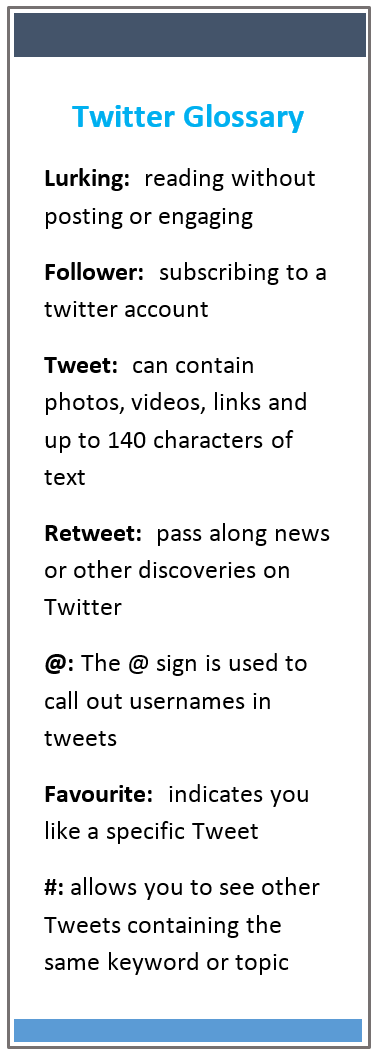
The extent of my social media experience on Twitter kicked off with a year ‘lurking’,Twitter Glossary followed by months of sporadic ‘retweeting’.  Six months ago I agreed to represent Contact social media presence at our annual International Suicide Prevention, What Works? conference by live conference tweeting – no pressure!!

Not only was I sending out speaker soundbites from the official corporate @ContactNI page while concurrently composing my own @CarrieMo_gomery tweets and reading / retweeting what came through on the conference hashtag #ContactWhatWorks15, also conscious our hashtag takes up a precious 18 / 140 character limit, multi-tasking on four devices, two smartphones to separate out the corporate V personal photos coupled with two separate tablets to maintain the two Twitter accounts.  All resulted in me holding the home button on my phone a millisecond too long so that during our service commissioner of all peoples presentation in the magnificent Titanic Centre, Belfast that Siri shouted out ‘I’m not sure I understand what you are saying’ to the not quite contained laughter of the A/V team.  Agghhhh!!!!

Suicide Prevention Social Media

After addressing the elephant in the room over the potential risks of social media in suicide prevention – with research finding benefits outweigh risks… at AAS 2015 I was introduced by the fabulous #SPSM (Suicide Prevention Social Media) team to:

  • Twitter visualRetweet and mention reach – #SPSM reaching a staggering 11 million individuals over a 12 month period, raising awareness on suicide prevention
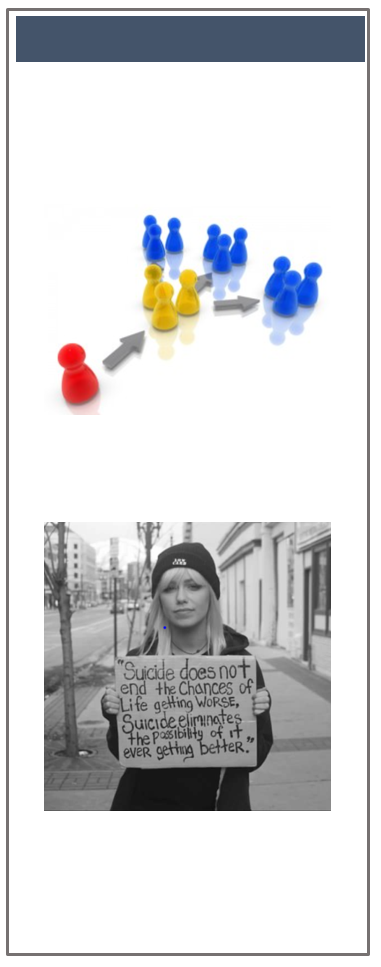
  • Memes or ideas spread through images typically humorous – ‘an image can say much more than the twitter 140 character limit and increases retweet potential by 35%
  • Storify – creating stories by importing content from timelines e.g. compiling all tweets shared about specific conference keynote speakers which can then be used as conference notes

And of course Twitter Chats…..

It was no surprise following their compelling and energetic workshop that #SPSM founders, Dr April Foreman and Tony Wood, were presented with the AAS conference Roger Tierney Award.


Twitter Chats… creating community?

Keen to learn more, and no better time to start than during Mental Health Awareness Month… this week I engaged in twitter chats for the first time.

I sat down on Sunday evening with a view to simply lurking on #BPDChat, a weekly chat, this week focusing on ‘Reasons for living: Building a life worth living’ moderated by Carl Dunn. Tea in hand I began to read the posts. I was

Meme

very encouraged by the positive message of hope but felt somewhat voyeuristic about reading without engaging. Prompted by a tweet that said professionals welcome, I nervously took my first step towards tweet chatting and outed myself with ‘Listening in (lurking) from Belfast, Ireland…. Great to read the messages of #hope and recovery’. Ok…. breath – I did it!!

I was not anticipating the immediate welcoming responses and felt, dare I say… connected!

With this positive experience behind me… another evening, another twitter chat. Monday evening, I sat down looking forward to #MHTalk moderated by PCORI focusing on ‘how patient & clinician involvement is making a difference in mental health research’. Expecting a similar experience and determined to engage more fully, sat down ready to chat….

What the…?!?!?!? Was I ever glad PCORI had issued a pre-chat tweet encouraging those joining to use a tool like TweetChat.com or Twubs.com to follow the conversation real-time. This was fast paced and I was only just getting time to read the question and consider a response when the tweets started to flood in. Fifteen minutes in and I spotted a tweet announcing ‘Awesome #MHTalk is trending on Twitter!’… boy did I know it! I finally acclimatised by the seventh question and with relief managed to get involved in what was a dynamic and interesting conversation that otherwise would not have been available to me. This time left with a sense of… belonging.

Ok… now more familiar with the format of Twitter chats and this time prepared with my Twubs.com tool and multiple devices– just in case, on Wednesday evening I joined #SuicideChat (moderated by AFSP National with Ursula Whiteside on online suicide prevention). This should be interesting… I heard Ursula speak at AAS on Zero Suicide within healthcare systems, providing her unique lived experience / clinician-researcher perspective.

I was able to keep up this time but felt somewhat shy about giving my opinions on the topic among the online suicide prevention national US ‘experts’.   I settled myself and give my contribution to the final two questions. My incoming alerts were making music… my tweets received no less than thirty favourites and new followers. What was going on… what I had said that was notable?! This time I felt in some way validated on the contribution I could make to suicide prevention social media.


Impact of reaching out…. reach, new followers, lists

Over the past few weeks taking the risk to experiment via social media… I have most definitely felt connected:

  • Reaching >425k in the month I attended AAS discussing the contribution to suicide prevention made by researchers, clinicians, social activists and those with lived / personal Generation Yexperience.
  • Reaching >210k (so far) during Mental Health Awareness Month
  • Being added to lists such as suicide prevention, mental health advocates, medical-online and leadership.
  • Making a connection with a fellow traveller on a lazy Saturday morning that progressed into a tele-meeting by Monday.
  • Quadrupling my number of followers still quite modest and doubling the number of people I follow as keen to hear more about what they say and the resources they share.

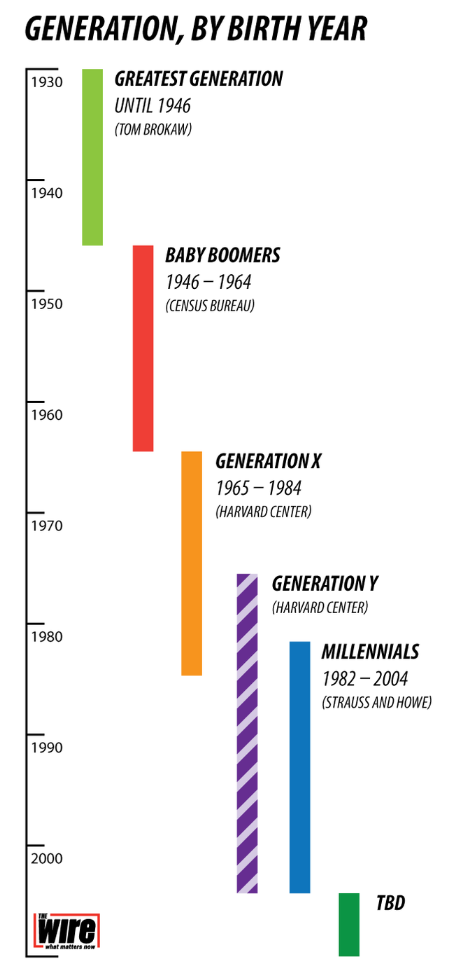
I have concluded that embracing the potential of social media as a vehicle to connect suicide prevention communities and raise awareness on the support available has left me confident, sitting on the boundary between Gen X and Gen Y, that I hold the ‘technology wise’ traits of generation Y.

Interested to hear your experiences and thoughts…

If you are affected by any of these issues, check out my resources post here that includes detailed support services and guidelines for talking about social media online

Suicide Prevention resources

Suicide Prevention – resources